Sponsored
Sponsored
Free Edition
Verified Content
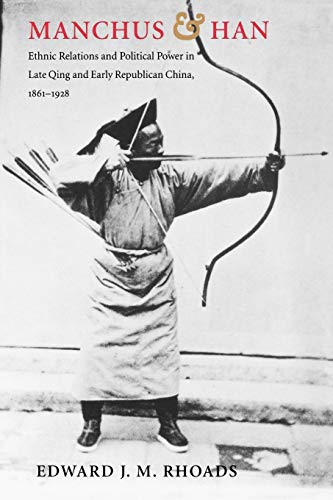
Manchus and Han: Ethnic Relations and Political Power in Late Qing and Early Republican China, 1861-1928 (Studies on Ethnic Groups in China)
Overview
China's 1911-12 Revolution, which overthrew a 2000-year succession of dynasties, is thought of primarily as a change in governmental style, from imperial to republican, traditional to modern. But given that the dynasty that was overthrown--the Qing--was that of a minority ethnic group that had ruled China's Han majority for nearly three centuries, and that the revolutionaries were overwhelmingly Han, to what extent was the revolution not only anti-monarchical, but also anti-Manchu?
Edward Rhoads explores this provocative and complicated question in Manchus and Han, analyzing the evolution of the Manchus from a hereditary military caste (the "banner people") to a distinct ethnic group and then detailing the interplay and dialogue between the Manchu court and Han reformers that culminated in the dramatic changes of the early 20th century.
Until now, many scholars have assumed that the Manchus had been assimilated into Han culture long before the 1911 Revolution and were no longer separate and distinguishable. But Rhoads demonstrates that in many ways Manchus remained an alien, privileged, and distinct group. Manchus and Han is a pathbreaking study that will forever change the way historians of China view the events leading to the fall of the Qing dynasty. Likewise, it will clarify for ethnologists the unique origin of the Manchus as an occupational caste and their shifting relationship with the Han, from border people to rulers to ruled.
Winner of the Joseph Levenson Book Prize for Modern China, sponsored by The China and Inner Asia Council of the Association for Asian Studies
Edward Rhoads explores this provocative and complicated question in Manchus and Han, analyzing the evolution of the Manchus from a hereditary military caste (the "banner people") to a distinct ethnic group and then detailing the interplay and dialogue between the Manchu court and Han reformers that culminated in the dramatic changes of the early 20th century.
Until now, many scholars have assumed that the Manchus had been assimilated into Han culture long before the 1911 Revolution and were no longer separate and distinguishable. But Rhoads demonstrates that in many ways Manchus remained an alien, privileged, and distinct group. Manchus and Han is a pathbreaking study that will forever change the way historians of China view the events leading to the fall of the Qing dynasty. Likewise, it will clarify for ethnologists the unique origin of the Manchus as an occupational caste and their shifting relationship with the Han, from border people to rulers to ruled.
Winner of the Joseph Levenson Book Prize for Modern China, sponsored by The China and Inner Asia Council of the Association for Asian Studies
Finding high-quality digital editions shouldn't be a challenge. With instant access to our curated library, you can start your journey with Aftermath immediately. Whether on your phone, tablet, or e-reader, the story of Raleigh's life is presented in a format designed for modern readers.
To get started finding Manchus and Han: Ethnic Relations and Political Power in Late Qing and Early Republican China, 1861-1928 (Studies on Ethnic Groups in China), you are right to find our website which has a comprehensive collection of titles listed. Our library is one of the most comprehensive resources for free digital reading materials, providing verified and safe content for book lovers worldwide.


36,114 currently reading


152,889 want to read
Sponsored
Sponsored
Book details & editions
| ISBN | 0295980400 |
| Publisher | N/A |
| Publication date | September 2000 |
| Language | English |
| Pages | pages |
| Reading Options | PDF · EPUB · Mobi |
Sponsored
Sponsored




Ratings & Reviews
5 ★
81.4%
4 ★
14.6%
3 ★
3%
2 ★
0.6%
1 ★
0.4%
4.76
BlueReads Choice
Sponsored
Write a Review
Community Reviews
Sort by: